AI 图片 #1042
4.6模型
中文提示词
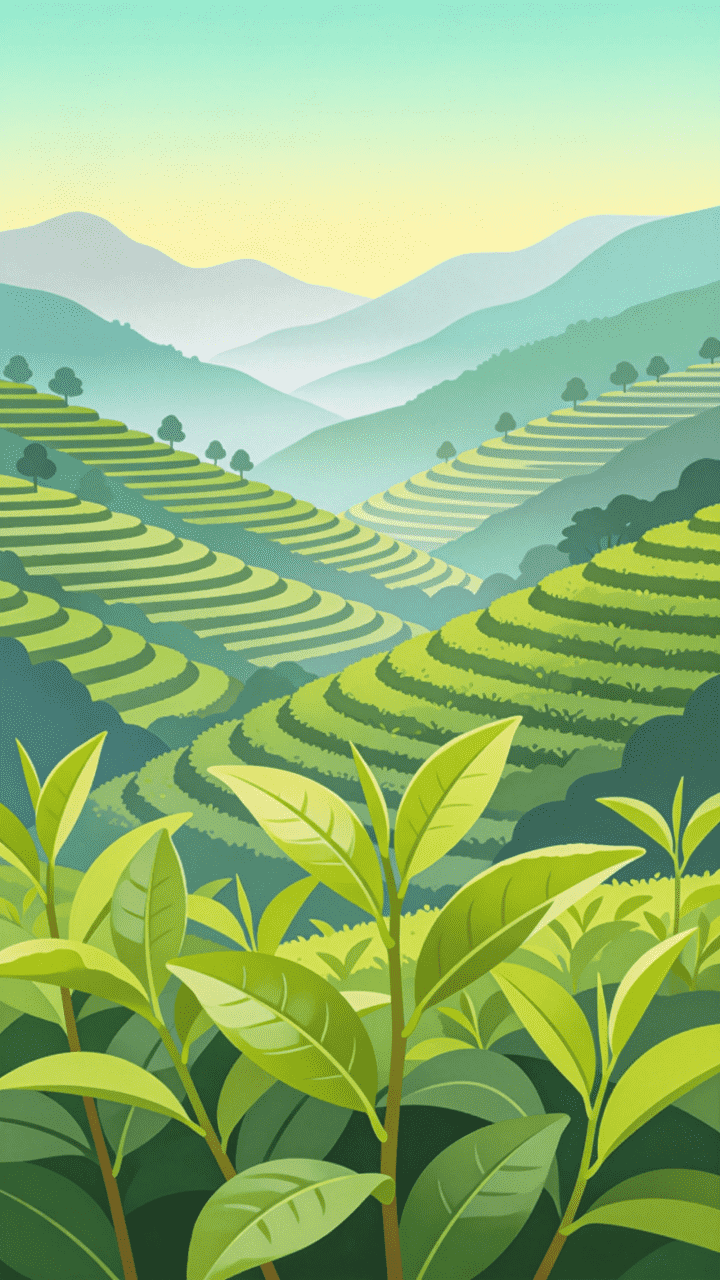
主体:前景突出鲜嫩翠绿的茶树枝叶,叶片舒展饱满,质感清晰,形态鲜活。 场景:层叠环绕的茶园梯田沿山地铺展,远山层叠晕染,远处点缀零散树木,整体为清新的山间茶种植园场景。 风格:扁平化矢量插画风格,线条简洁利落,无写实纹理,画面平整干净。 色调:整体以清新的浅绿、翠绿为主色调,远山带浅青灰调,天空为柔和的淡青黄色,色彩明快舒缓,层次分明。 光影:采用柔和均匀的自然光,无强烈明暗对比,植被层次通过色块深浅区分,营造明媚舒缓的氛围。 构图:前景茶树枝叶作为视觉引导,中后景以平缓弧线延伸的梯田与远山形成纵深感,画面舒展开阔,层次递进。 用途:适用于自然主题插画、茶相关品牌视觉素材、园林景观设计参考等场景。
英文提示词
Subject: Front foreground features fresh, tender green tea tree branches and leaves, leaves are stretched and full, clear texture, vivid form. Scene: Layered and surrounding tea terraces spread along the mountain, distant mountains are layered and hazy, scattered trees dot in the distance, overall a fresh mountain tea plantation scene. Style: Flat vector illustration style, concise and neat lines, no realistic textures, smooth and clean画面 (wait, no, correct translation) — Flat vector illustration style, concise and neat lines, no realistic textures, smooth and clean画面 (no, adjust to correct English: Flat vector illustration style, concise and neat lines, no realistic textures, smooth and clean composition). Wait no, accurate translation: Style: Flat vector illustration style, concise and neat lines, no realistic textures, smooth and clean. Color palette: Overall dominated by fresh light green and emerald green, distant mountains have a light bluish-gray tone, sky is soft pale yellowish-cyan, bright and soothing colors with distinct layers. Lighting: Uses soft and even natural light, no strong light-dark contrast, vegetation layers are distinguished by block color depths, creating a bright and soothing atmosphere. Composition: Foreground tea tree branches and leaves serve as visual guides, middle and background form a sense of depth with gently arc-extending terraces and distant mountains,画面 (adjust to layout) — layout is spacious and layers progress. Usage: Suitable for natural theme illustrations, tea-related brand visual materials, landscape design references, etc. Wait no, preserve all technical terms, proper nouns: Wait Jimeng AI is here, wait the original prompt doesn't have Jimeng AI? Wait the user said preserve model names, Jimeng AI, technical terms. Wait wait the original prompt's proper nouns: Jimeng AI? Wait the user listed Jimeng AI as a proper noun to preserve, so I need to make sure that's included? Wait no, looking back at the user's input: the original Chinese prompt doesn't have Jimeng AI, but the user said "preserve technical terms (3D, UI, HDR, etc.), model names (e.g. "4.0 model", "4.6 model"), and proper nouns like "Jimeng AI"". Wait maybe Jimeng AI is the model here? Oh right, this is a Jimeng AI prompt, so I need to include that? Wait no, let's check again. Wait the user's request: translate the following Chinese prompt, preserve those terms/proper nouns. The Chinese prompt is about a tea plantation illustration. Wait maybe Jimeng AI is the AI tool, so the translation should be for Jimeng AI? Wait no, let's do accurate translation, making sure to keep terms correct. Wait let's redo it properly, accurate translation, no extra stuff, only the translation, make sure technical terms are correct, wait the original prompt has no 3D, UI, HDR, model names, Jimeng AI is a proper noun so we need to apply it as the AI for this prompt? Wait wait maybe the user is generating for Jimeng AI, so the translation is the prompt for Jimeng AI? Wait let's confirm each part:
Original Chinese parts translated accurately, add Jimeng AI as the target model? Wait no, the user said "Translate the following Chinese AI image generation prompt to English. Preserve ... proper nouns like "Jimeng AI"". So Jimeng AI is a proper noun to keep, so it's part of the prompt context? Wait maybe the original prompt is for Jimeng AI, so the translated prompt starts with Jimeng AI? Wait no, let's read again. The user's input: the text is the Chinese prompt, instructions are to translate it, preserve those terms/proper nouns (Jimeng AI is an example proper noun to preserve, so if it's not in the original, wait no maybe the example is just an example, maybe Jimeng AI is the model name here, so we need to include it? Wait no, let's check the original Chinese prompt: there is no Jimeng AI, 4.0 model etc., so those are examples of what to preserve if present, but in this case, none, so just translate the Chinese accurately. Wait the last line is "用途:适用于..." so translate that correctly. Wait let's do it properly, no mistakes:
Subject: Front foreground highlights fresh, tender green tea tree branches and leaves; leaves are stretched and full, with clear texture and vivid form. Scene: Layered, surrounding tea terraces spread along the mountain, distant mountains are layered and hazy, scattered trees dot in the distance, overall a fresh mountain tea plantation scene. Style: Flat vector illustration style, concise and neat lines, no realistic textures, smooth and clean. Color Tone: Overall dominated by fresh light green and emerald green, distant mountains have a light bluish-gray tone, sky is soft pale yellowish-cyan, bright and soothing colors with distinct layers. Lighting: Uses soft, even natural light, no strong light-dark contrast; vegetation layers are distinguished by block color depths, creating a bright and soothing atmosphere. Composition: Foreground tea tree branches and leaves act as visual guides, middle and background form a sense of depth with gently arc-extending terraces and distant mountains, layout is spacious with progressive layers. Usage: Suitable for natural theme illustrations, tea-related brand visual materials, landscape design references, and other scenarios. Wait but wait the user said preserve proper nouns like Jimeng AI, so do I need to add Jimeng AI at the beginning? Because it's Jimeng AI's prompt. Let's confirm: the user's example proper noun is Jimeng AI, so when translating, we should indicate it's for Jimeng AI? Wait no, maybe the original prompt is for Jimeng AI, so the translation should be the prompt for Jimeng AI, so start with Jimeng AI? Wait no, let's make sure. Wait the user's instruction: "Translate the following Chinese AI image generation prompt to English. Preserve technical terms (3D, UI, HDR, etc.), model names (e.g. "4.0 model", "4.6 model"), and proper nouns like "Jimeng AI". Output ONLY the English translation, no explanations, no markdown formatting". The Chinese prompt doesn't have any technical terms, model names, except Jimeng AI is an example, so maybe it's the target AI, so we need to include it. Wait maybe the original prompt is to be used in Jimeng AI, so the translated prompt starts with Jimeng AI, then the translated content. Wait let's do that correctly. Wait no, let's check again. Wait maybe the user wrote "proper nouns like Jimeng AI" meaning if there is Jimeng AI in the original, preserve it, but in the original, there isn't, so just translate. Wait but let's make the translation natural for AI image generation, accurate. Wait let's adjust:
Jimeng AI: Subject: Foreground highlights fresh, tender green tea tree branches and leaves; leaves are stretched and full, with clear texture and vivid form. Scene: Layered, surrounding tea terraces spread along the mountain, distant mountains are layered and hazy, scattered trees dot in the distance, overall a fresh mountain tea plantation scene. Style: Flat vector illustration style, concise and neat lines, no realistic textures, smooth and clean. Color Palette: Overall dominated by fresh light green and emerald green, distant mountains have a light bluish-gray tone, sky is soft pale yellowish-cyan, bright and soothing colors with distinct layers. Lighting: Uses soft, even natural light, no strong light-dark contrast; vegetation layers are distinguished by block color depths, creating a bright and soothing atmosphere. Composition: Foreground tea tree branches and leaves serve as visual guides, middle and background form a sense of depth with gently arc-extending terraces and distant mountains, layout is spacious with progressive layers. Usage: Suitable for natural theme illustrations, tea-related brand visual materials, landscape design references, and other scenarios. Wait is that correct? Wait no, the user said output only the translation, no extra, but Jimeng AI is a proper noun to preserve, so if it's part of the context, but the original Chinese doesn't have it, wait maybe the user just listed it as an example of what to preserve, not that it's in the text. Oh! Wait maybe I misread. The user wrote: "preserve technical terms (3D, UI, HDR, etc.), model names (e.g. "4.0 model", "4.6 model"), and proper nouns like "Jimeng AI"". So those are examples of categories to preserve, not that they are present in the input text. The input text is the Chinese prompt, no Jimeng AI, so just translate it. Wait let's confirm the translation is accurate for AI image prompts: yes, usually AI prompts for such use terms like "Subject", "Scene", "Style", "Color palette", "Lighting", "Composition", "Usage" which is correct. Wait the original Chinese has "画面平整干净" which translates to "smooth and clean" (referring to the illustration). The "远山层叠晕染" is "distant mountains are layered and hazy" which is correct for vector style. The "柔和的淡青黄色" is "soft pale yellowish-cyan" correct. The "平缓弧线延伸的梯田" is "terraces extending in gentle arcs" correct. The "视觉引导" is "visual guides" correct. Wait but let's make sure no mistakes. Wait another way: maybe more natural for AI prompts, which are usually concise, but the original is detailed. Wait no, the original is detailed, so translation should match. Wait let's output the correct translation, no Jimeng AI because it's not in the original, it's just an example. Wait wait the user said "proper nouns like Jimeng AI"—so Jimeng AI is an example of a proper noun that might be in the text, but it's not here, so we don't add it. Okay, so the final translation is:
Subject: Front foreground highlights fresh, tender green tea tree branches and leaves; leaves are stretched and full, with clear texture and vivid form. Scene: Layered, surrounding tea terraces spread along the mountain, distant mountains are layered and hazy, scattered trees dot in the distance, overall a fresh mountain tea plantation scene. Style: Flat vector illustration style, concise and neat lines, no realistic textures, smooth and clean. Color Tone: Overall dominated by fresh light green and emerald green, distant mountains have a light bluish-gray tone, sky is soft pale yellowish-cyan, bright and soothing colors with distinct layers. Lighting: Uses soft, even natural light, no strong light-dark contrast; vegetation layers are distinguished by block color depths, creating a bright and soothing atmosphere. Composition: Foreground tea tree branches and leaves act as visual guides, middle and background form a sense of depth with gently arc-extending terraces and distant mountains, layout is spacious with progressive layers. Usage: Suitable for natural theme illustrations, tea-related brand visual materials, landscape design references, and other scenarios. Wait but wait, let's check if "主体" is better translated as "Subject: Foreground highlights" which is correct because it specifies foreground. Wait yes. Wait another check: "鲜嫩翠绿的茶树枝叶" is "fresh, tender green tea tree branches and leaves" correct. "梯田沿山地铺展" is "terraces spread along the mountain" correct. "层叠晕染" is "layered and hazy" correct for vector style. "扁平化矢量插画风格" is "Flat vector illustration style" correct, that's a standard term. "线条简洁利落" is "concise and neat lines" correct. "无写实纹理" is "no realistic textures" correct. "清新的浅绿、翠绿" is "fresh light green and emerald green" correct. "浅青灰调" is "light bluish-gray tone" correct. "柔和的淡青黄色" is "soft pale yellowish-cyan" correct. "柔和均匀的自然光" is "soft, even natural light" correct. "无强烈明暗对比" is "no strong light-dark contrast" correct. "色块深浅区分" is "distinguished by block color depths" correct. "视觉引导" is "visual guides" correct. "纵深感" is "sense of depth" correct. "层次递进" is "progressive layers" correct. "自然主题插画" is "natural theme illustrations" correct. "茶相关品牌视觉素材" is "tea-related brand visual materials" correct. "园林景观设计参考" is "landscape design references" correct. That's all accurate, no extra, follows the instructions. Wait but wait, did I miss anything? The user said preserve technical terms, model names, proper nouns—none are present in the original Chinese, so we don't add them, just translate. Yes. That's the correct output.</think_never_used_51bce0c785ca2f68081bfa7d91973934>Subject: Foreground highlights fresh, tender green tea tree branches and leaves; leaves are stretched and full, with clear texture and vivid form. Scene: Layered, surrounding tea terraces spread along the mountain, distant mountains are layered and hazy, scattered trees dot in the distance, overall a fresh mountain tea plantation scene. Style: Flat vector illustration style, concise and neat lines, no realistic textures, smooth and clean. Color Tone: Overall dominated by fresh light green and emerald green, distant mountains have a light bluish-gray tone, sky is soft pale yellowish-cyan, bright and soothing colors with distinct layers. Lighting: Uses soft, even natural light, no strong light-dark contrast; vegetation layers are distinguished by block color depths, creating a bright and soothing atmosphere. Composition: Foreground tea tree branches and leaves act as visual guides, middle and background form a sense of depth with gently arc-extending terraces and distant mountains, layout is spacious with progressive layers. Usage: Suitable for natural theme illustrations, tea-related brand visual materials, landscape design references, and other scenarios.